Mapping the B2B Buyer Journey: The Complete Playbook
Align Sales, Marketing, and CS around a single buyer journey — with clear stage definitions, exit criteria, and the GTM foundation every other RevOps project depends on.


Table of contents
1. Introduction to the Project
Description
The Buyer Journey Matrix is a strategic framework that aligns an organization's Sales, Marketing, and Customer Success teams around a single, shared definition of the customer's path. It provides a "black and white" document that outlines what happens in each stage of the journey, who has ownership and responsibility for what, and the key actions required to move a prospect forward. By documenting the journey, we create a common language and a single source of truth for all departments. The purpose is to gain full visibility and comprehension of the entire pipeline, from initial touchpoint to renewal and beyond.
Problems that this solves
- Departmental Silos & Misalignment: It directly addresses the problem of sales and marketing having differing definitions of what constitutes a qualified lead. By integrating Customer Success, it also resolves disconnects between the sales handoff and the post-sale implementation and adoption process. It also helps Customer Success and Marketing know how to better work together to gather leads from current customers. Overall, provides a consistent framework for internal and external communication about deal progression and
- Inefficient Handoffs: The matrix facilitates a smoother and more efficient handoff of records between departments. With clear entry and exit criteria for each stage, teams know exactly what information is needed to pass a record to the next phase, ensuring a frictionless process.
- Disorganized Development: It prevents teams from building processes or technologies in a disorganized way. By providing a consistent blueprint for all automation and system configuration, it allows for intentional and focused development rather than scattered, ad-hoc solutions. Helps understand which tools/development are required and when, helping have an efficient structure in which Hubspot, Salesforce, and other tools can be used at their best.
- Inconsistent Communication: The playbook establishes a consistent framework for internal and external communication about deal progression and customer status. This improves clarity and builds trust across the business, as everyone is using the same terminology and working toward the same goals.
Definition of success
Success is achieved when all departments are aligned on a single set of definitions and their roles in the buyer’s journey. This leads to increased efficiency and faster deal progression. The alignment allows teams to build technology and automations with clear purpose, reducing wasted effort, and unnecessary system bloat.
Ultimately, the objective is to create a predictable and repeatable GTM process that drives measurable improvements in deal velocity, conversion rates, and win rates, and that extends to a greater customer retention and satisfaction.
2. When to Implement?
Client pain points that may trigger the project
- Sales reps are overwhelmed by an undifferentiated list of leads with varying levels of quality.
- Marketing lacks visibility into which content or channels are generating the most valuable pipeline and, ultimately, revenue.
- The team observes low engagement and poor conversion rates after leads are handed off from marketing to sales.
- Sales and marketing teams are misaligned on what a "high-quality" lead is, or sales leadership does not trust the quality of leads being passed to them.
- The company plans a major restructuring of its lifecycle or pipeline stages.
- Accuracy of the information in the Pipeline doesn't reflect the reality.
- Forecasting and predictability present a challenge since the path that opportunities follow in the Pipeline don’t show any clear trend.
- The sales process is inconsistent from rep to rep.
- Sales, Marketing, and CS work in silos and do not build momentum together.
- Sales, Marketing, and CS have different definitions or difficulty communicating about each stage, e.g. MQL, SQL, etc.
The right time to implement this project (prerequisites)
This project is a fundamental prerequisite for almost any other strategic initiative related to the sales process. It should be implemented before making any changes to a client's contact, lifecycle, lead, opportunity, or deal stages. A well-defined buyer journey is the foundation upon which more complex projects are built. Without this foundational map, other projects run the risk of being inconsistent, inaccurate, or ultimately ineffective.
3. KPIs
Mapping the customer journey directly impacts and helps measure a number of key performance indicators (KPIs) across the entire business.
- Speed to Lead (SLA): By clearly defining the handoff from marketing to sales, this project enables the creation of a clean SLA (Service Level Agreement) for follow-up times. This improves the speed at which a new lead is contacted, a key driver of successful conversions.
- Deal Velocity: By defining each stage and its exit criteria, we'll establish a single, aligned measurement across the entire company. This helps align the sales team on the definition of each stage instead of letting them move opportunities from stage to stage based on vibes, or misaligned information. This shared understanding will allow us to trust the deal velocity metric, enabling us to accurately identify bottlenecks and pinpoint specific areas for improvement in our sales process later down the road.
- Stage Duration: A detailed journey map provides the ability to measure the average time a lead or opportunity spends in each stage in a more consistent way. This data is crucial for accurate forecasting, for optimizing specific phases of the process, and also for training the team on how to move the customer through the buyer journey, preventing stalled deals/opps.
- Conversion Rate: The matrix provides clear handoff points, allowing for measurement to be consistent across the company in terms of conversion rates between stages (e.g., from MQL to SQL, or from Stage 1 Discovery to Stage 2 Proposal). This visibility enables teams to focus on improving conversion at specific points.
- Win Rate: Mapping the buyer's journey gives our sales reps a clear, step-by-step playbook for every deal. By defining each stage and its criteria, we remove the guesswork from the sales process, allowing reps to know exactly how and when to engage with prospects. This efficiency ensures that reps spend their time on the highest-value activities, leading to a higher win rate and more predictable revenue.
- Sales Rep Capacity & Efficiency: By automating handoffs and eliminating ambiguity (part of a future project, not included in this playbook), reps can focus on high value leads and have clear next steps for their day to day work. Lead scoring and prioritization are part of another playbook, but important to have in mind the connection between them: when high value leads are identified, and we make Sales Reps connect directly with them using automations, they can make a better use of their time.
- Lifetime Value (LTV): For B2B, the customer journey extends beyond the initial closed-won deal. By mapping the post-sale journey (e.g., onboarding, adoption, renewal), we can identify opportunities for upselling and cross-selling, which increases retention and the overall value of the customer.
- Referrals handling related metrics: This mapping helps marketing and CS align on a referral gathering and nurture strategy, so metrics related to that area take place into this project.
4. Client Roles Involved
This project requires deep involvement from key stakeholders across the organization.
- Marketing Leadership: Provides the initial definitions of the top-of-funnel stages (e.g., Prospect, MQL). Their input is critical for aligning marketing efforts with sales goals and for providing context on lead sources and attribution.
- Sales Leadership: Offers critical insights into the sales process, including deal progression, velocity, and the "happy path" of a successful sale. They help define the mid- and late-funnel stages and provide feedback on the quality of leads.
- Sales Representatives: As the end users of the process, reps provide invaluable, on-the-ground feedback on the practicality and efficiency of the proposed stages, criteria, and automations.
- Customer Success Leadership: Provides insight into the post-sale customer journey, including adoption metrics, retention challenges, and upsell opportunities. Their input helps close the feedback loop, ensuring that the sales process is designed to deliver not just deals, but successful, long-term customers.
- Marketing Operations: For all those cases in which we’re not the ones who handle the technical aspects such as creating fields, building automations, and ensuring data integrity, this team will be responsible for this part of the work. It’s more likely to be in our court, but there would be cases in which this role is played by the client’s internal Ops team.
5. Tools/Technologies
The tools and technologies listed here are not for creating the structure itself, but are the technologies that the client needs to have in place to execute and automate the customer journey.
- CRM (Salesforce/Hubspot): The central hub for the entire process. It's used to define Opportunity stages, create custom fields and flows to manage the journey, and track all sales activities. For pre-pipeline stages, in case we’re implementing a pre-pipeline opportunity framework, Salesforce uses negative stages (Stage -3, -2, -1) to manage leads before they become true opportunities. In Hubspot we use the Lead Object.
- Marketing Automation Platform (HubSpot): Often used for the top-of-funnel stages. HubSpot can serve as the pre-pipeline for the customer journey before a contact is passed to sales. If a client is HubSpot-centric, as mentioned before, they can use the Lead object to represent this pre-pipeline journey.
- Data Enrichment (ZoomInfo, Apollo): These tools are essential for automatically enriching records with firmographic and demographic data. This helps in lead qualification and territory assignment, especially during the marketing-to-sales handoff.
- Sales Engagement (Gong, Outreach): Tools like Gong are used for sales enablement and to provide a source of interaction data (e.g., call recordings, email touches) that can serve as a trigger in the buyer journey. These interactions often indicate a prospect's readiness to move to the next stage.
- Lead Routing (Chili Piper): Automates the process of assigning leads to the correct sales representative based on predefined rules, which is critical for ensuring a fast "speed to lead" time.
- Template Spreadsheets: We will use a dedicated template spreadsheet to capture and align on the matrix definitions before any technical implementation begins. This document serves as a collaborative framework for all stakeholders.
6. Questions before Implementation
Before beginning any implementation, we must have a discovery phase to gather critical information. These questions should be asked to the departments that are involved in each part of the buyer’s journey (Sales, Marketing, and Customer Success). All information we gather will help us identify any misalignments.
Need to Know Before Starting the Project
- Who are the key stakeholders from sales, marketing, and Customer Success that will provide input and approval?
- What are your current definitions for Lead, Contact, Contact Lifecycle, and Deal/Opportunity stages?
- How do you currently define an MQL, SQL, SAL, etc.?
- What are the exit criteria for each stage of your current pipeline?
- What information is required for sales to efficiently work the leads they receive?
- What is the "happy path" for a record in your system today?
- Are there any specific business units or products that should be treated differently in the journey?
- What are the current pain points between marketing, sales, and Customer Success with regard to lead handoff and customer onboarding?
- Do you have any existing SLAs for "speed to lead" or rep follow-up times?
- What types of content or resources are used at each stage of the buyer journey (e.g., case studies, demos, pricing sheets)?
- How are leads currently routed to your sales team?
- What are the most common reasons deals are lost or stalled in the current pipeline?
- What are the most critical metrics for your business right now (e.g., deal velocity, conversion rate, win rate)?
Nice to Know
- What are your short-term (6-month) and long-term (18-month) business goals?
- What does your current marketing and sales reporting look like? What dashboards do you use?
- What channels or sources are currently generating the highest quality leads (e.g., inbound, outbound, referrals, events)?
- How does the process differ if a lead enters through a different channel (e.g., inbound vs. outbound, company hosted event vs referral)?
- What is your internal definition of a "champion" or a key decision-maker within a target account?
- How is your sales team structured (e.g., inbound/outbound, by territory, by industry)?
- How are existing customers categorized or segmented (e.g., by industry, company size, ARR)?
- What is the typical sales cycle length for your different products or services?
- Are there any specific contract or legal requirements that influence the sales process?
Related but Not Always Relevant
- What tools and technologies are currently in your stack for sales, marketing, and Customer Success?
- Do you have a process in place for handling re-engagements from previously disqualified leads?
- How do you define a "good" vs. a "bad" fit prospect? What criteria are used for disqualification?
- Do you have any existing lead scoring models in place?
- How do you handle upsell, cross-sell, and renewal opportunities for existing customers?
- How do you track post-sale customer engagement and health today?
- What are the primary sources of customer support tickets or service requests?
7. Additional Details and Context
As discussed, This project's main goal is to align sales, marketing and customer success on a common process. The platform and strategy we implement will depend on the client's existing ecosystem and goals.
Also, it’s important to mention that for any buyer journey implementation we recommend to set up pre-pipeline stages, this helps Pipeline and Forecast accuracy since it moves to Pipeline only those prospects that meet certain types of qualification. It also eliminates the need to track prospects through multiple objects (i.e. lead to contact to opportunity).
This playbook is designed to be a guide for any platform approach (.e.g Hubspot only, Hubspot-Salesforce, etc), allowing us to adapt our strategy to the client's existing infrastructure.
The two most common approaches in a B2B SaaS context are:
- HubSpot-centric: The Lead object is utilized to represent prospects in the pre-pipeline stages. The journey begins with a Lead and is handled by a Sales Rep through different stages until it reaches a point of qualification, at which time it is converted into a Deal.
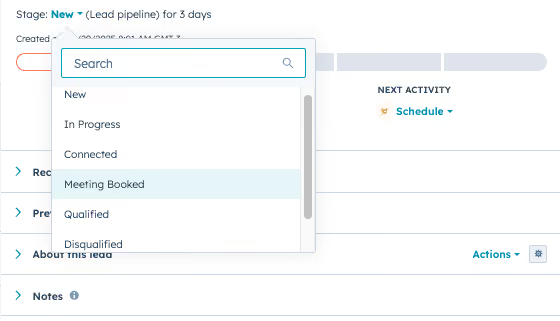
Once this conversion happens, we’re talking about a Deal that went through an initial discovery and counts for Pipeline and forecasting. After the Deal is marked as closed won, this one is passed to the Customer Success team for the onboarding process and subsequent renewals.
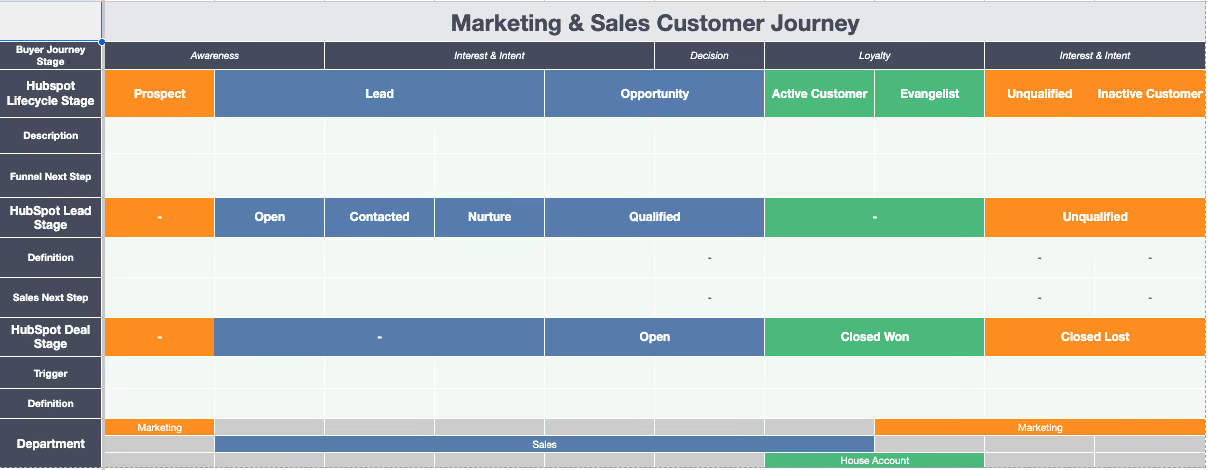
The matrix for this type of cases looks like this. Notice that in the top part of the matrix it’s mentioned the Buyer Journey Stage. Then in the middle the definition in each path (Lifecycle Stage, Lead Stage, Deal Stage) and the department that plays a key role in that very moment.
- Salesforce Opportunity-centric: The Lead object in Hubspot is not used. Instead, the journey begins with a Contact that has been captured in Hubspot and then sent to Sales in Salesforce. Here we’ll have a Contact, an associated Account and there will be an Opportunity created for the purpose of the negotiation.
In this case, the pre-pipeline stages are represented as negative stages within the Opportunity object (e.g., Stage -3 Target Prospect, Stage -2 Nurtured Lead, Stage -1 Qualified Lead), which are then converted to Stage 0 and beyond.

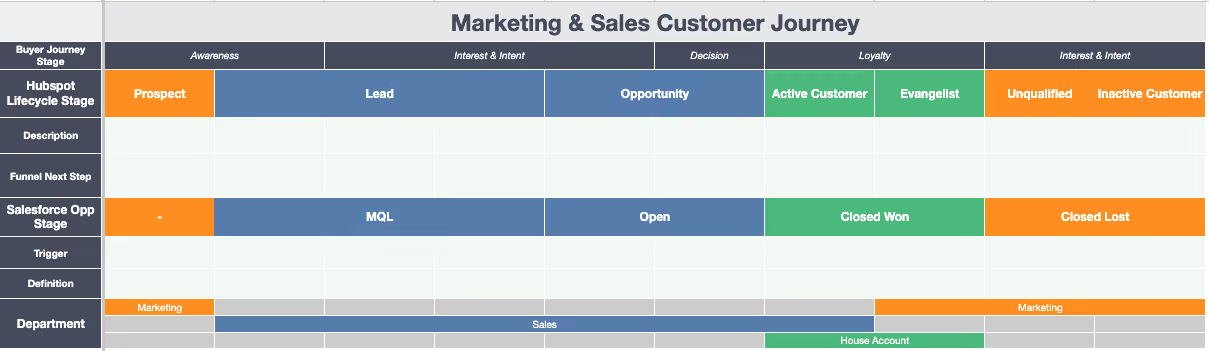
Similar to the previous case, the matrix for this scenario looks like this. Notice that in the middle of the table it’s shown how the Pre-Pipeline part of the journey (mentioned as MQL) is set before the Open stage, that is the actual Pipeline part of the journey. This is also reflected on the Lifecycle Stage in Hubspot, that is equivalent to Opportunity.
8. Step by Step
This section outlines the key phases of the project, from initial discovery to final enablement. For the estimations about time to complete we’re using a 100 hr/month account as an example, where this project is the main priority. So when you’re estimating your project, have in mind that the number of hours and the priority might have an impact on the delivery time.
Phase 1: Discovery & Alignment.
Estimate time for this phase: 2 sprints
- Project Kickoff: Hold an initial meeting with all key stakeholders (Sales, Marketing, RevOps, Customer Success) to introduce the project, define its scope, and get buy-in.
- Information Gathering: Use the questions from Section 6 to conduct interviews with leaders from all three teams to understand their current processes, definitions, and pain points.
- Current State Analysis: Analyze the existing CRM data and reporting to understand how records currently flow through the system.
- Propose the Matrix: Based on the information gathered, draft the first version of the buyer journey matrix, outlining proposed stages, triggers, and ownership.
Phase 2: Implementation & Technical Build
Estimate time for this phase: 4 sprints
5. Review and Finalize: Present the proposed matrix to the stakeholders for feedback. Incorporate their comments to finalize the definitions and criteria.
6. Build the Foundations: In a sandbox environment, create the necessary custom fields, and build the foundational flows that support the new journey. The goal of this is being able to show the solution in place before moving to Production. Also, another goal for this is to share proofs of concept/updates of what you’re building to ensure you’re on the right track. As a best practice, keep the main stakeholders in the loop by sending Loom videos and daily messages with your progress.
7. Data Migration Strategy: Plan and test the process for converting existing leads into contacts and opportunities, ensuring no data loss.
8. Test & Validate through User Acceptance Testing (UAT): Conduct thorough testing to ensure all automations and flows work as expected. This includes testing edge cases and scenarios with new records.
To make sure our tests are helpful for the process to move forward, we need to focus our efforts considering all possible scenarios described by the client in the buyer journey matrix. We discussed initially that it’s important to know what are the different paths a prospect can go through in their way to a closed won opportunity, and this is one of the reasons why it’s important: because help us replicate the conditions when testing for ensuring that the solution we’re building meets the needs expressed at the moment of the discovery. Consider the different channels, situations and edge cases in your testing using different records for each one. The idea is to have all possibilities mapped before the end users start testing.
Important to mention that our testing process continues until deployment, because in each step of the road, we’ll receive feedback and comments, which we’ll need to replicate and incorporate to ensure the process is 100% adjusted to reality.
After we’ve done testing the solution vs the process that was described by the client, it's a best practice to guide a User Acceptance Testing (UAT) process. UAT is an instance where the end-user (such as a department head or a sales rep) tests the process and shares their insights in a tracker created for this purpose.
We structure it in two parts. In the first round, the department head performs a test based on their knowledge of the team's needs. We then make corrections to the process and send it back to them for sign-off. The second round of UAT involves the end-user, the sales rep, who performs the test and shares their insights. As with the previous round, we take the feedback, make adjustments, and send it back for sign-off. After this, we'll be ready to proceed with training and move toward deployment.
Phase 3: Enablement & Delivery
Estimate time for this phase: 4 sprints
9. Training & Documentation: Create training materials ( SOPs, slide decks and videos) to educate the sales, marketing, and Customer Success teams on the new process. Also, build a "backfill" plan to ensure existing opportunities are aligned with the new pipeline stages. As a note, we recommend offering ourselves to guide the training sessions, even if the client didn’t ask yet.
10. Go-Live: Deploy the new process to production and execute the data migration plan. Consider backing up the information and including all elements that will need to be adjusted in the new ecosystem.
11. Post-Deployment Support: Provide dedicated support during the first few weeks to address any issues or questions immediately. Depending on the engagement we can do this by messaging them in the shared channel (where all the team has visibility), following up in the dedicated tracker for issues,and keep communication with the head of each department. Important to reinforce in all communication touches that we’re available for any need they have.
12. Review & Iterate: After the first month from the deployment, schedule a follow-up session to review the new process, gather feedback, and identify opportunities for optimization.
9. Possible Problems
Stakeholder Misalignment on Definitions
- Description: The sales, marketing, and Customer Success teams have different views on what a qualified lead is, leading to confusion and distrust.
- Solution: Facilitate an alignment workshop during the discovery phase. Create a clear, written matrix with a common language that is approved by all parties before any technical build begins. It’s in our court to set the conditions for all this misalignments to be resolved, for example, in the workshop, narrate the insights all the teams have to describe the happy path of the buyer and definitions, to evidence which parts are aligned and which parts need to be worked. We’re here to ensure all departments have what they need for the process to run smoothly. Every required piece of information, or action needs to be captured here and discussed for a straightforward process.
Resistance to Change and Low Adoption
- Description: Sales reps may be reluctant to adopt the new process, especially if they are used to a different workflow.
- Solution: Involve reps early in the discovery and design process. Clearly communicate the benefits of the new system (e.g., less time spent on unqualified leads, a more predictable pipeline). Provide comprehensive training and easy-to-access documentation. Create elements in the UI for helping users in their day to day tasks (.e.g, error messages, help text in properties, screenflow with guidance for success)
Poor Data Quality or Missing Information
- Description: Automations fail because critical data points (e.g., state, company name) are missing or inaccurate in the initial records.
- Solution: Establish a data enrichment process using tools like ZoomInfo. Build flows that identify records with missing data and route them to a specific queue for manual review. Set clear expectations with the client that data accuracy is an ongoing effort.
Busy Stakeholders
- Description: Key leaders are too busy to provide feedback in a timely manner, which can slow down the project.
- Solution: Set clear expectations for time commitment from the start. Schedule shorter, focused meetings and send concise updates. Use asynchronous communication and shared documents to keep the project moving forward. Adapt your communication and resources, make straightforward questions, use colors and emojis to make your message clear, share guidance and release pressure from stakeholders. Be creative, don’t take things personal and make the best use of their time.
10. Summary
List of possible next steps:
- Develop a custom dashboard to track key metrics like Sales Velocity and Stage Duration after go-live.
- Now that you have the customer path in order, you can reframe leadership reports with this information and add new metrics based on the key actions you outlined in the process.
Recurring or follow-up tasks generated:
- Quarterly (or yearly depending on the business) reviews with sales, marketing, and Customer Success leadership to ensure the matrix remains relevant.
- Regular data audits to check for data quality and process adherence.
- Bi-weekly check-ins during the first month post-deployment to address any friction points.
When should you revisit this?
This project should be revisited every 12 months for a full review. It should also be reviewed sooner if major changes occur, such as a new product launch, new marketing channels, or significant shifts in conversion trends.
What projects does this unlock?
A well-defined buyer journey matrix is the key to unlocking more advanced projects, such as:
- Building a more sophisticated lead scoring model.
- Advanced sales attribution and reporting.
- Enhanced team-specific dashboards.
- A/B testing of engagement signals.
- An automated lead nurturing process
- Consistent speed-to-lead reporting.
- Consistent Opp Velocity reporting.