
Setting Up the Pre-Pipeline Instance: The Complete Playbook
Stop pipeline bloat and wasted rep time. Set up a Pre-Pipeline instance in HubSpot or Salesforce that filters unqualified leads before they hit your main pipeline.

Table of contents
This playbook serves as a guide for establishing or optimizing a client's Pre-Pipeline instance. Its primary purpose is to ensure that Sales Reps only dedicate their time to genuinely qualified prospects, which helps the company increase efficiency and pipeline accuracy.
1. Introduction to the Project
Description
The Pre-Pipeline Setup is the definition and implementation of the initial stages a prospect goes through before they become a fully forecastable opportunity in the main Sales Pipeline. This instance serves as a qualification and nurturing environment where Marketing and Sales can evaluate and filter out leads based on the available data and how well they fit into the ICP. It requires creating specific stages, clear entry/exit criteria, and automations, usually utilizing the native Lead object (in HubSpot) or negative stages within the Opportunity object (in Salesforce). By segregating the qualification stages, we dramatically improve the quality of the primary Sales Pipeline.
Problems that this solves
- Pipeline Bloat & Inaccuracy: It prevents the main Sales Pipeline from being cluttered with unqualified prospects that will never close, making forecasting unreliable.
- Wasted Sales Capacity: Sales Reps stop wasting time following up on cold or unready leads, allowing them to focus exclusively on high-value, high-intent prospects.
- Lead Handoff Friction: It formalizes the handoff from MQL to SQL, providing a clear, documented process with mutual accountability, reducing distrust over lead quality.
- Disorganized Nurturing: It structures the nurturing process for leads that are "good, but not ready yet," ensuring they are engaged systematically rather than being abandoned or passed directly to Sales prematurely.
- Departmental Silos & Misalignment: It directly addresses the problem of sales and marketing having differing definitions of what constitutes a qualified lead, which generates a deal/opportunity.
- Inconsistent Communication: The playbook establishes a consistent framework for internal and external communication about deal progression and customer status in the earliest stages of the sales process. This improves clarity and builds trust across the business, as everyone is using the same terminology and working toward the same goals.
- Seamless Funnel Re-entry: It allows prospects to enter the pipeline multiple times for different products or re-engagement without requiring complex custom builds, solving the Salesforce limitation where converted Contacts cannot be reverted to Leads.
- Unified Reporting Architecture: It resolves disjointed reporting by eliminating the need to cross-reference Lead, Contact, and Opportunity objects, allowing for a single Opportunity report to track volume and conversion from Stage -1 to 0.
- Historical Data Integrity: It prevents the overwriting of critical timestamp data (e.g., "became MQL" or "became SQL" dates) when a prospect re-engages, ensuring historical performance numbers remain stable and accurate rather than decreasing over time as records are updated.
Definition of success
Success is achieved when the Sales Pipeline is significantly cleaner, reflecting only one object to take care of (opportunities) and not multiple ones (lead, contact, opportunity, account, etc). This leads to demonstrable increases in Deal Velocity and Win Rates due to improved focus. The Marketing and Sales teams must be fully aligned on the criteria for moving a prospect from the Pre-Pipeline to the main Pipeline, and Sales Reps admin tasks are reduced, as they take care of fewer items, which gives them more time for actual sales actions.
2. When to Implement?
Client pain points that may trigger the project
- Sales Leadership does not trust the accuracy of the current Sales Pipeline, fearing it is filled with "junk."
- Deal Velocity is slow because reps spend too much time disqualifying prospects that should not have been in the Pipeline. Here we make sure that prospects have met certain criteria before converting and passing to sales.
- The client is using two separate systems (e.g., a Marketing Automation Platform and a CRM) and needs to define the handoff point clearly.
- Forecasting accuracy is poor, and Sales Leadership needs a more predictable sales process.
- Clients have prospects who can enter the pipeline multiple times and their historic data is being overwritten
- Clients have a hard time reporting on how many MQLs were qualified by sales
The right time to implement this project (prerequisites)
This project must be implemented after the core Buyer Journey has been mapped and defined (as described in this other playbook, Mapping the B2B Buyer Journey). The client must have a standardized set of definitions for qualification (MQL, SQL, etc.) and ownership assigned to the Pre-Pipeline stages (e.g., Marketing, Sales, Customer Success). Without this foundational map, defining the stages of the Pre-Pipeline might be inconsistent and arbitrary.
3. KPIs
The Pre-Pipeline directly impacts the accuracy and efficiency of the sales funnel.
- MQL to SQL Conversion Rate: Measures the efficiency of the Pre-Pipeline qualification process. As a note, we could even see the conversion rate of pre-MQL records to MQL, so the reporting is even richer.
- Deal Velocity: By only allowing high-quality prospects into the main pipeline, the time it takes to move deals from Stage 1 to Closed-Won should decrease noticeably.
- Sales Rep Efficiency: Reps' time spent on discovery and qualification should shift to time spent on proposal and negotiation.
- Disqualification Rate: Tracks how many leads are disqualified before they hit the main pipeline, proving the efficiency of the screening mechanism.
- Pipeline Accuracy: The ratio of Qualified Opportunities in the Pipeline versus Total Opportunities in the Pipeline.
- Speed to Deal: By clearly defining the handoff from marketing to sales (Pre-Pipeline to actual Pipeline), this project helps streamline the process and reduce follow-up times. This improves the speed at which a new deal lands in the actual pipeline.
- Win Rate: A more qualified set of prospects sent to sales ensures that sales reps dedicate their time to the right activities, ultimately leading to a higher win rate. This is a direct result of better-qualified leads entering the pipeline.
- Speed to Lead: It reduces response times by isolating high-intent prospects from the noise, ensuring Sales Reps can immediately identify and engage with "hand-raisers" the moment they enter the funnel, rather than losing hours sifting through cold or unqualified leads.
4. Client Roles Involved
This project requires deep involvement from key stakeholders across the organization.
- Sales Leadership: Defines the minimum requirements a prospect must meet to justify the-Rep's time. We’re talking about MQL to SQL definition.
- Marketing Leadership: Owns the initial stages (where MQL land) and ensures lead volume and quality meet the Pre-Pipeline entry requirements.
- Sales Reps: The primary users and owners of the mid-stages of the Pre-Pipeline (e.g., Lead Statuses, first touchpoints). Their feedback on qualification criteria is crucial.
- Revenue Operations/ Marketing Operations (when the client has these departments): Responsible for providing feedback and their expertise on the current processes and reporting side of things.
5. Tools/Technologies
These tools are essential for executing the qualification and handoff within the Pre-Pipeline instance.
- CRM (Salesforce/Hubspot): The central hub for the entire process. It's used to define Opportunity/Deal stages, create custom fields and automations to manage the journey, and track all sales activities. For pre-pipeline stages, Salesforce uses negative stages (Stage -3, -2, -1) to manage leads before they become true opportunities. In Hubspot we use the Lead Object.
- Marketing Automation Platform (HubSpot): Often used for the top-of-funnel stages. HubSpot can serve as the pre-pipeline for the customer journey before a contact is passed to sales. If a client is HubSpot-centric, as mentioned before, they can use the Lead object to represent this pre-pipeline journey.
- Lead Routing (Chili Piper for example): Automates the instantaneous assignment of Deals/Opportunities to the correct Sales Rep.
- Data Enrichment (ZoomInfo, Clay): Used to ensure records entering the Pre-Pipeline have all firmographic and demographic data needed for qualification criteria to be met.
- Sales Engagement (Gong, Outreach): Tools like Gong are used for sales enablement and to provide a source of interaction data (e.g., call recordings, email touches) that can serve as a trigger in the process of a Deal/Opportunity progressing in the Pipeline.
6. Questions before Implementation
These questions focus specifically on the current process and thresholds needed to define the Pre-Pipeline stages.
Need to Know Before Starting the Project
- Who are the key stakeholders from sales, marketing, and customer success teams that will provide input and approval on the MQL/SQL criteria?
- How do you currently define an MQL, SQL, and SAL?
- What are the current stages/statuses that a lead goes through before it is considered a full Opportunity?
- What is the required exit criteria for a record to move from a qualified lead state (e.g., SQL) into the main Sales Pipeline?
- What is the required information that must be confirmed for sales to efficiently work the leads they receive, and who is responsible for capturing that data?
- What is the "happy path" for a prospect in the Pre-Pipeline today (i.e., the ideal sequence of events)?
- What are the current pain points between Marketing, SDRs, and Sales with regard to lead qualification and handoff quality?
- Do you have any existing SLAs for "speed to lead" or rep follow-up times for qualified leads?
- How are leads currently routed to your SDR or Sales team?
- What types of content or engagement signals are used to indicate a prospect is ready to move from a passive Nurturing state to active Qualification?
- What are the most common reasons records are disqualified or sent back from Sales to Marketing in the current process? Are there any disqualification reasons that you would want to block from re-entering later? (Usually spam or junk, but reasons like budget or timing we would defining want to allow back through)
- Are there any specific business units, channels or product lines that should have different qualification criteria in the Pre-Pipeline?
- How are you currently reporting on MQL volumes and conversion rates?
- If a prospect has an open opportunity, would you want a new opportunity created if they show interest in another product?
- What are all of the signals that should automatically generate a pre-pipeline opp? How reliable is your lead scoring?
- Would you want an opp created if they score-up enough?
- What does your current Marketing and Sales reporting look like for the top of the funnel? What dashboards do you use?
- Do you have a process in place for handling re-engagements from previously disqualified leads?
Nice to Know
- What are your short-term (6-month) and long-term (18-month) business goals related to sales team efficiency and pipeline quality?
- What channels or sources are currently generating the highest quality leads?
- How is your sales team structured (e.g., inbound/outbound, by territory, by industry)?
- What is your internal definition of a "champion" or a key decision-maker within a target account?
- How does the lead qualification process differ if a lead enters through a different channel
- What tools and technologies are currently in your stack for qualification, sales engagement, and data enrichment?
- Do you have any existing lead scoring models in place?
- How do you define a "bad" fit prospect? What criteria are used for hard disqualification?
- What types of content or engagement resources are used at each stage of the Pre-Pipeline?
- What is the typical sales cycle length for your different products, channels or services?
7. Additional Details and Context
- Focus on Disqualification: The success of the Pre-Pipeline relies as much on defining what qualifies a prospect as it does on defining the clear, automated criteria for disqualification. A swift disqualification process ensures the team's focus remains sharp.
- Pre-Pipeline ≠ Nurturing: While the Pre-Pipeline houses leads that need nurturing, the Pre-Pipeline stages themselves are about active qualification and handoff. Leads not ready for qualification should be moved to a specific Marketing Nurturing status or campaign.
- Platform Dependency:
- HubSpot-centric: The Lead Object is the ideal home for the Pre-Pipeline. The Lead Status field manages the stage progression until conversion to a Deal.
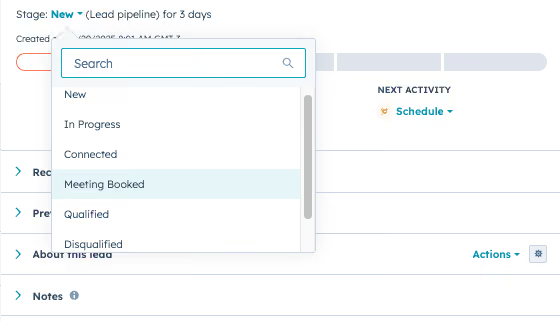
- Salesforce Opportunity-centric: Since a true Opportunity is needed for the negotiation, the Pre-Pipeline is represented using negative stages within the Opportunity object (e.g., Stage -3, -2, -1) to track qualification before the opportunity hits the main sales pipeline (Stage 0/Open).

8. Step by Step
This section outlines the key phases of the project, from initial discovery to final enablement. For the estimations about time to complete we’re using a 100 hr/month account as an example, where this project is the main priority. So when you’re estimating your project, have in mind that the number of hours and the priority might have an impact on the delivery time.
Important to mention that this section covers an implementation in Salesforce. For an implementation in Hubspot please refer to this Playbook
Phase 1: Discovery & Alignment.
Estimate time for this phase: 2 sprints
1. Project Kickoff: Hold an initial meeting with all key stakeholders (Sales, Marketing, RevOps, Customer Success) to introduce the project, define its scope, and get buy-in.
2. Information Gathering: Use the questions from Section 6 to conduct interviews with leaders from all three teams to understand their current processes, definitions, and pain points.
3. Current State Analysis: Analyze the existing CRM data and reporting to understand how records currently flow through the system.
4. Propose the Pre-Pipeline Instance: Based on the information gathered, draft the first version of the Pre-Pipeline Instance, outlining proposed stages, triggers, and ownership.
Phase 2: Implementation & Technical Build
Estimate time for this phase: 4 sprints
5. Review and Finalize: Present the proposed Pre-Pipeline Instance to the stakeholders for feedback. Incorporate their comments to finalize the definitions and criteria.
6. Build the Foundations: In a sandbox environment, create the necessary custom fields, and build the foundational flows that support this instance. The goal of this is being able to show the solution in place before moving to Production. Also, another goal for this is to share proofs of concept/updates of what you’re building to ensure you’re on the right track. As a best practice, keep the main stakeholders in the loop by sending Loom videos and daily messages with your progress. Don’t be afraid to overcommunicate.
7. Data Migration Strategy: Plan and test the process for converting existing leads into contacts and opportunities, ensuring no data loss.
8. Test & Validate through User Acceptance Testing (UAT): Conduct thorough testing to ensure all automations and flows work as expected. This includes testing edge cases and scenarios with new records.
To make sure our tests are helpful for the process to move forward, we need to focus our efforts considering all possible scenarios described by the client when describing their process and pain points. We discussed initially that it’s important to know what are the different paths a prospect can go through in their way from the very initial stage to the actual pipeline, and this is one of the reasons why it’s important: because help us replicate the conditions when testing for ensuring that the solution we’re building meets the needs expressed at the moment of the discovery. Consider the different channels, situations and edge cases in your testing using different records for each one. The idea is to have all possibilities mapped before the end users start testing.
Important to mention that our testing process continues until deployment, because in each step of the road, we’ll receive feedback and comments, which we’ll need to replicate and incorporate to ensure the process is 100% adjusted to reality.
After we’ve done testing the solution vs the process that was described by the client, it's a best practice to guide a User Acceptance Testing (UAT) process. UAT is an instance where the end-user (such as a department head or a sales rep) tests the process and shares their insights in a tracker created for this purpose.
We structure it in two parts. In the first round, the department head performs a test based on their knowledge of the team's needs. We then make corrections to the process and send it back to them for sign-off. The second round of UAT involves the end-user, the sales rep, who performs the test and shares their insights. As with the previous round, we take the feedback, make adjustments, and send it back for sign-off. After this, we'll be ready to proceed with training and move toward deployment.
Phase 3: Enablement & Delivery
Estimate time for this phase: 4 sprints
9. Training & Documentation: Create training materials (SOPs, slide deck, videos) to educate the sales, marketing, and Customer Success teams on the new process. Also, build a "backfill" plan to ensure existing opportunities are aligned with the new Pre-Pipeline stages. As a note, we recommend offering ourselves to guide the training sessions, even if the client didn’t ask yet.
10. Go-Live: Deploy the new process to production and execute the data migration plan. Consider backing up the information and including all elements that will need to be adjusted in the new ecosystem
11. Post-Deployment Support: Provide dedicated support during the first few weeks to address any issues or questions immediately. Depending on the engagement we can do this by messaging them in the shared channel (where all the team has visibility), following up in the dedicated tracker for issues, and keep communication with the head of each department. It is important to reinforce in all communication touches that we’re available for any need they have.
12. Convert Existing Leads to Contacts and Create Accounts: In this step you’ll need to identify the criteria for converting existing leads to contacts and create accounts for those. For example, all leads after XX/XX/XX except those that have been disqualified. For this purpose you might need to use the autoconvert package we’ve created in our Salesforce instance.
13. Review & Iterate: After the first month from the deployment, schedule a follow-up session to review the new process, gather feedback, and identify opportunities for optimization.
9. Possible Problems
- Stakeholder Misalignment on Qualification:
- Solution: Formalize the Exit Criteria (MQL to SQL) in a written SOP that is approved by both Sales and Marketing Leadership. Use validation rules to ensure all required fields are populated before a lead can exit the Pre-Pipeline.
- Data Gaps for Qualification:
- Solution: Integrate data enrichment tools (ZoomInfo) early in the Pre-Pipeline process. Build automated flags that push records with missing qualification data back to Marketing for nurturing or dedicated data collection.
- Resistance to Disqualification:
- Solution: Clearly communicate that disqualifying leads early is a measure of efficiency, not failure. Tie SDR/BDR compensation metrics to the quality of leads passed, not just the quantity.
- Resistance to Change and Low Adoption
- Solution: Involve reps early in the discovery and design process. Clearly communicate the benefits of the new system (e.g., less time spent on unqualified leads, a more predictable pipeline). Provide comprehensive training and easy-to-access documentation. Create elements in the UI for helping users in their day to day tasks (.e.g, error messages, help text in properties, screenflow with guidance for success)
- Busy Stakeholders
- Solution: Set clear expectations for time commitment from the start. Schedule shorter, focused meetings and send concise updates. Use asynchronous communication and shared documents to keep the project moving forward. Adapt your communication and resources, make straightforward questions, use colors and emojis to make your message clear, share guidance and release pressure from stakeholders. Be creative, don’t take things personal and make the best use of their time.
10. Summary
List of possible next steps:
- Develop a custom dashboard focused solely on Pre-Pipeline performance metrics (MQL to SQL Conversion Rate, Disqualification Volume).
- Build automated sequences in Sales Engagement tools (Outreach) aligned with the new Pre-Pipeline stages.
- Build a "backfill" plan to ensure existing opportunities are aligned with the new pre-pipeline stages.
- Integrate a lead scoring model that automatically moves prospects through the initial (Marketing-owned) Pre-Pipeline stages.
Recurring or follow-up tasks generated:
- Quarterly (or yearly depending on the business) reviews with sales, marketing, and Customer Success leadership to ensure the Pre-Pipeline Instance remains relevant.
- Regular data audits to check for data quality and process adherence.
- Bi-weekly check-ins during the first month post-deployment to address any friction points.
What projects does this unlock?
- Accurate Sales Forecasting (The most immediate benefit).
- Implementation of advanced Lead Scoring and Predictive Lead Grading.
- Lead Routing and SLA enforcement.
- Detailed Sales Attribution modeling (since you know exactly when a lead becomes qualified).