How RevBlack works: what you see before you sign, and what happens after
Before you sign anything, you see what’s broken in your CRM, the plan to fix it and the consultants who’ll do the work. Here’s how the steps fit together.


Before I started RevBlack, I ran RevOps in-house at a company called Grow. Every so often we hit a technical problem we couldn't solve alone, or needed more capacity, so we hired outside RevOps consultants. Too often the work got more complicated than it needed to be. And the person who sold us the engagement disappeared once the contract was signed.
I built RevBlack's process to work the other way. It has five steps, and you see the first three before you sign anything:
- Auditing your tech stack and RevOps
- Building your roadmap
- Meeting your team
- Doing the work
- Scaling what's working
Step 1: Auditing your tech stack and RevOps
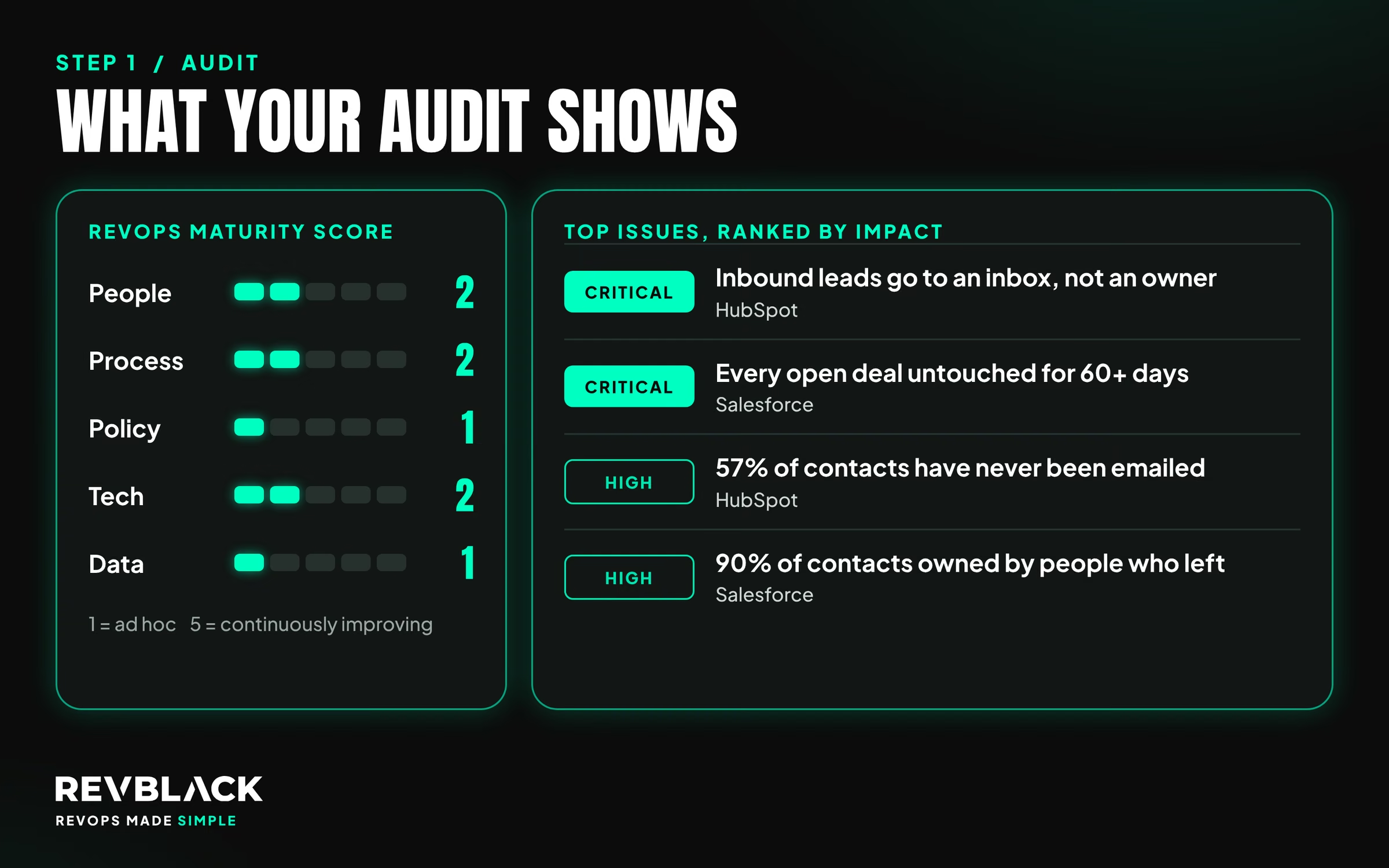
The audit tells us what's actually broken before anyone changes anything. A doctor runs tests before prescribing medication, and a good mechanic looks under the hood before starting work, because coming in with a chainsaw before you know what's wrong would be malpractice.
We review two things. First, your go-to-market tech stack, meaning HubSpot or Salesforce and everything connected to it: marketing automation, Gong, Outreach, Salesloft, Clay, and any data or AI tools. Second, the state of your RevOps, using our RevOps maturity assessment. That tells us whether you have the right tools and need a better process, or whether a tool is what's holding you back.
We start here because a lot of RevOps work goes wrong the same way. Someone picks a solution and starts building before anyone has defined the problem. It's ready, fire, aim.
Most of what the audit turns up won’t surprise you. Maybe you have a crappy view into your open pipeline, or a CRM your sales team finds hard to use.
The value is in the specifics. A team may have known for years that its lead routing was broken, and the audit finds the exact step where it fails. In some audits we’ve found $30,000 or more a year going to tools nobody was using, and nobody had noticed. Turning those off saves that money right away.
The audit ends with problem statements and milestones we agree on together. Are we worth it? Is the ROI there? Those problem statements are how you'll answer that, because they become the standard you hold us to. To see what we check across your tools and how they connect, read how to run a tech stack audit.
Step 2: Building your roadmap
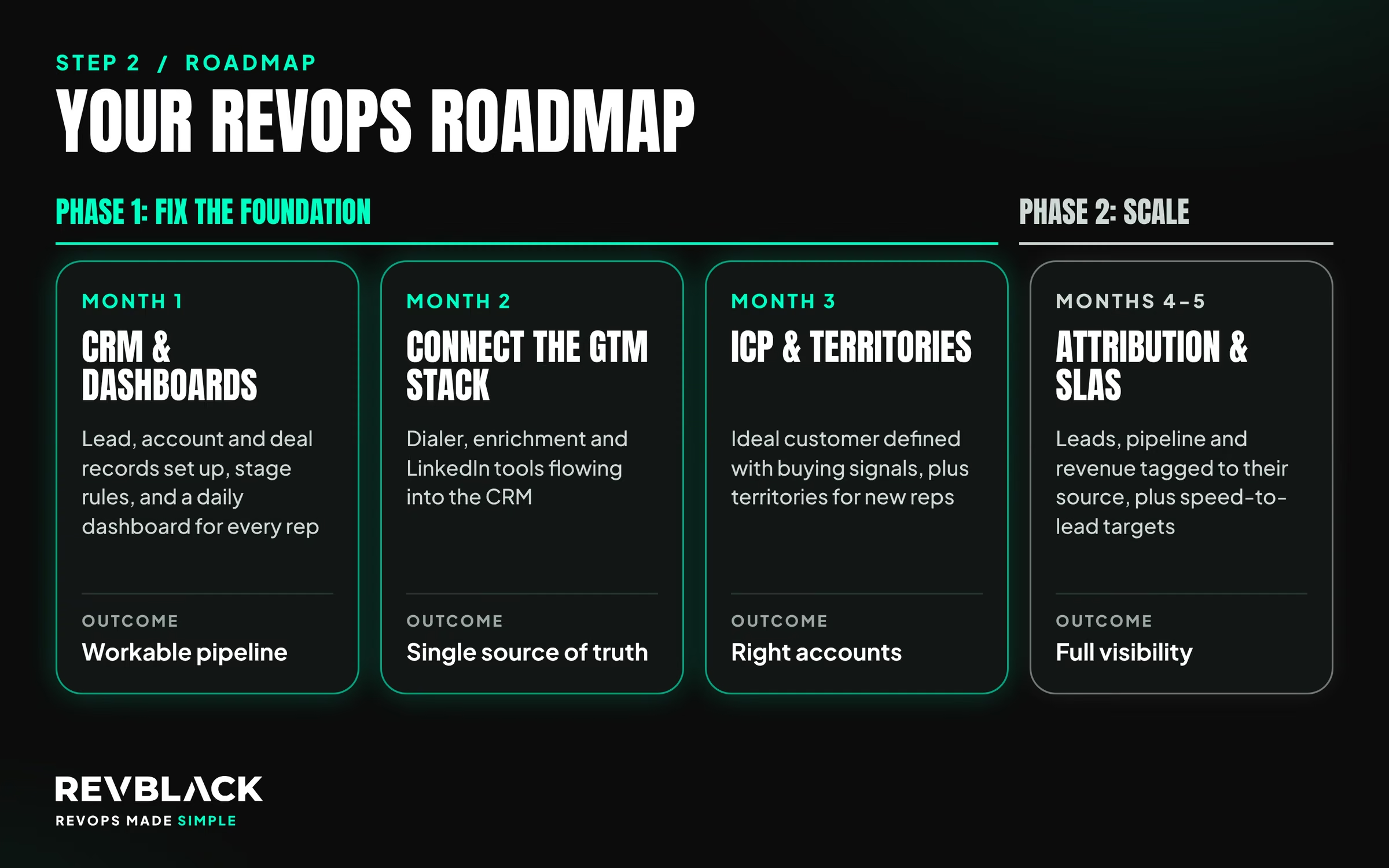
You see the roadmap before you sign a contract, and we make it as specific as we can, so you know exactly what you're signing up for.
Each audit finding becomes a project with a problem statement written so it can be checked. "Clean up the data" is a bad problem statement, because nobody can tell when it's done. "Clean up the data to an agreed standard so reps stop running into duplicates when they prospect" can be answered with a yes or a no.
ROI is our main filter, and the highest-ROI work comes down to generating more pipeline, converting more of it and closing it faster. Picture a team that closes 20 deals a month. If cleaner pipeline data and better deal routing got that to 25, that's five more deals a month without more ad spend or another hire, and a result you can take straight to your leadership team. We still make time for the routine admin that keeps the house from burning down, but most of the time goes to the work that moves those numbers.
Some requests don't belong on the roadmap, like changing the font color in your CRM or making everyone update their password. If a project won't improve a sales or marketing KPI, it isn't where your budget should go.
Every roadmap is different, because every business is at a different point. We don't invent a new solution each time, though. For problems we've solved before, we start from our own playbooks and size them to your business, the same way a doctor gives the same medicine to a small child and to a 250-pound adult in very different doses.
The roadmap is a living document, and we review it with you every week. Solving one problem often exposes the next. Fixing lead routing can uncover a speed-to-lead gap (how fast a rep follows up on a new lead), and fixing that can surface a close-rate problem. Your business changes too. Your biggest client cancels, you hire 10 new reps, you raise a new round, or a new CRO starts, and the roadmap changes with it. When priorities shift, we bring you the projects we think will have the biggest impact, like a new HubSpot feature that fixes a long-running issue, and nothing starts without your approval.
Step 3: Meeting our team
Before you sign anything, you meet the RevOps consultants who will do your work, and we pick them to fit your business and the way you like to work. We match on three things:
- They have experience in your industry.
- They know the tools you run.
- They fit how you like to work. Some clients are no-nonsense data people who want as much as possible handled over email or Slack, with spreadsheets instead of meetings. Others want to talk problems through live, and we’ll be that sounding board for them.
Getting to know how you work is part of the audit and roadmap conversations, so by Step 3 we already have a good idea of who will fit.
With a lot of RevOps agencies, you meet the founder or a charismatic salesperson, you sign, and then the work goes to someone you’ve never met. We put this step before the contract because you need to like the people you work with. If you dread the weekly meeting, the engagement won’t work, even when the work is good. You could be working with this person almost every day for the next six months, so you decide whether they’re the right fit before you commit.
Step 4: Doing the work
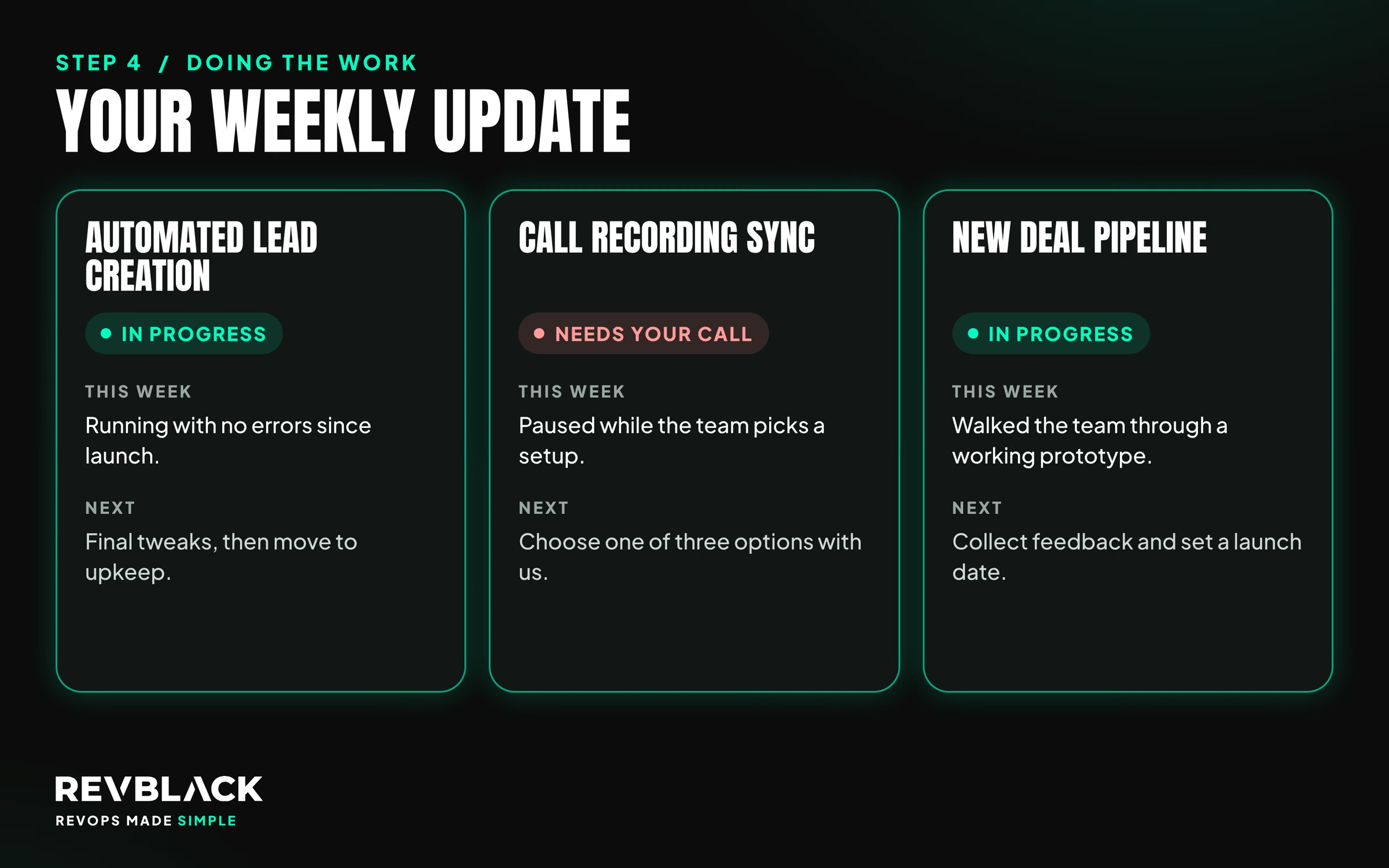
Once you’ve approved the roadmap and the team, we go heads down, but never quiet. Every week you get a written update and at least one meeting, and between those there’s a shared Slack or Teams channel for day-to-day questions.
The weekly update covers your priorities and where each roadmap item stands, and the meeting is where we confirm those priorities with you. The last thing we want is for you to look at finished work and say it isn’t what you wanted.
On your side, each project needs a day-to-day point of contact and a key stakeholder who knows that part of the business. A CPQ project (how quotes and pricing get built) needs someone from finance, and an attribution project needs someone from marketing. Some projects also need an executive sponsor. If you have a RevOps team, even a small one, they often act as the go-between.
We treat speed as part of quality, so we move as fast as access and approvals allow. When a fix uncovers the next problem, it goes on the roadmap that week instead of waiting for a quarterly review, and a lot of clients bring us in for exactly that.
Step 5: Scaling what's working
We call something a success when your KPIs move in the right direction and each problem statement passes its yes-or-no test. If the problem statement was cleaning up the data so reps stop running into duplicates, we check whether the duplicates are gone and whether reps are getting more meetings from their outbound. Depending on the work, the number we watch might be win rate or new deals from customers you already have.
When something works, the job shifts from fixing things to getting them ready for more. Say fixing lead routing doubled the number of leads marketing hands to sales each month. The next job is making sure your team and systems can handle twice the volume. The same goes for growth plans like hiring 10 more reps, or taking ad spend from $5,000 a month to $50,000, which only pay off if the systems behind them are ready first. That work goes on the roadmap, and the cycle starts again.
The team you met before signing is the same one that takes on each new problem, working from problem statements you’ve already agreed on. A company may eventually outgrow us, and once you’re a billion-dollar enterprise, you probably don’t need RevBlack anymore. But most companies have plenty of RevOps work ahead of them before that point, and we’re glad to take it on with you.
Is RevBlack the right fit for you?
We work best with companies that want to improve their RevOps because growth is the priority. Most reach us at the same point: what got them from zero to one won't get them from one to ten, and the systems that worked early start getting in the way.
That’s a big part of why we work well with private equity-backed companies. They’re under real pressure to hit their sales and marketing numbers, and they know the systems behind those numbers have to keep up with the growth.
If you’re still finding product-market fit, it’s usually too early for RevOps. At that stage the job is trying things and seeing what sells, and a spreadsheet can carry you a long way. RevOps starts paying off once you know what you’re selling and who’s buying it, and growth is the priority. That’s a good time to talk to us. If you’re comparing RevOps agencies, start with our questions to ask before you hire a RevOps agency.
Frequently asked questions
How long does it take to get started?
The first three steps usually take one to two weeks. Once we have access to your systems, the audit itself takes a day or two, and the rest of the time goes to reviewing the findings and agreeing on the roadmap with the right people on your team.
Do we need to be private equity-backed, or a certain size?
No. A lot of our clients are private equity-backed, but size and funding stage don’t decide whether RevOps will pay off. It can help a startup doing a couple million dollars a year, or a company doing hundreds of millions that’s fixing up one product line. What matters is that people are paying for what you sell, and that you have a team selling and marketing it.
What do you need from our team?
We need system access and a day-to-day point of contact. Each project also needs a key stakeholder: a CPQ project (how quotes and pricing get built) needs someone from finance, and an attribution project needs someone from marketing. Some projects also need an executive sponsor. If you have a RevOps team, even a small one, they often act as the go-between.
Why not hire a full-time RevOps person instead?
You can, but finding someone good in RevOps usually takes six months to a year, and if the hire doesn’t work out, you’re starting over. RevOps is also too broad for one person to cover alone. You need someone who can plan the strategy and someone who can build it in HubSpot or Salesforce. A fractional team, meaning an outside team that works with you part time, covers both and can start within a couple of weeks. Read more in why fractional RevOps beats a single RevOps hire.
Start with an audit
The first thing you get is a short list of problems, in writing, that every later result gets measured against. You’ll see that list, the roadmap built from it and the team who’ll do the work before you sign anything.